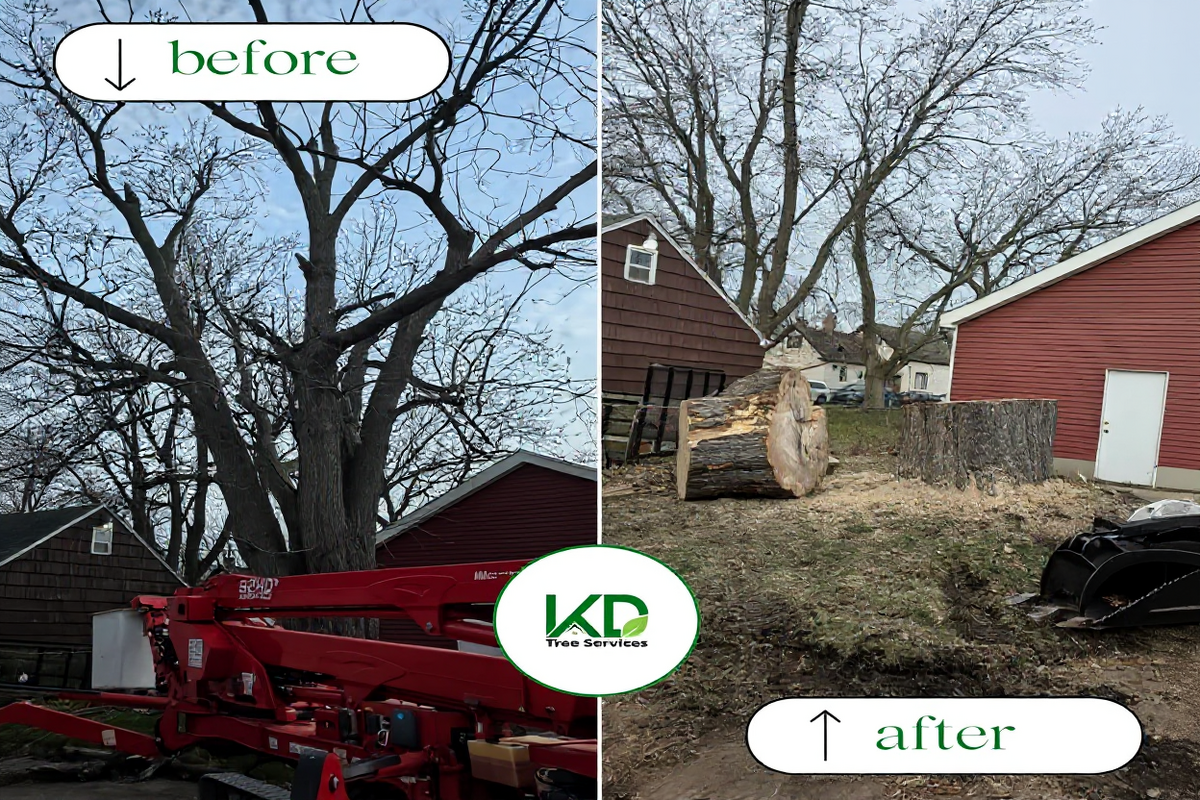
A large tree growing close to a house can become a serious removal challenge, especially when there is limited space for branches and heavy sections to come down safely.
That was the situation on a recent tree removal project in Albany, NY, completed by KD Tree Service Albany NY. The tree was located close to a residential property, so simply cutting it at the base and letting it fall was not a practical option.
Instead, the crew used crane assisted equipment, precision rigging, and controlled cutting techniques to remove the tree section by section while working carefully around the home, lawn, driveway, and surrounding property.
The project is a good example of why large tree removal requires planning, proper equipment, and experienced professionals.
Project Snapshot
| Project | Large residential tree removal |
|---|---|
| Location | Albany, NY |
| Main challenge | Large tree located close to the home |
| Removal method | Crane-assisted, controlled removal |
| Equipment | Crane and professional rigging equipment |
| Property concerns | Home, lawn, driveway, surrounding area |
| Final result | Tree removed and work area cleaned |
Why This Albany Tree Removal Required Careful Planning
Large trees cannot always be removed using the same approach as smaller trees.
When a tree is positioned in an open area, there may be enough room to safely control where sections come down. But when the tree is close to a house, driveway, fence, landscaping, or other structures, the available working space becomes much smaller.
In this Albany project, the tree's proximity to the residential property meant that the removal had to be carefully planned.
Before cutting began, the crew needed to consider the tree's structure, the location of the home, available equipment access, the safest removal sequence, and where individual sections could be lowered.
The objective was not simply to get the tree down.
The objective was to remove it in a controlled manner while reducing unnecessary risk to the property and people around the work area.
How the Large Tree Was Removed
For a difficult tree in a restricted residential area, removing the entire tree in one piece is often not practical.
A controlled sectional removal approach allows individual portions to be handled separately.
1. Assessing the Tree and Property
The first step is understanding the tree and everything around it.
Important considerations can include:
- Tree height and overall size
- Trunk condition
- Branch structure
- Lean and weight distribution
- Nearby buildings
- Driveways and landscaping
- Equipment access
- Potential landing areas
- Rigging requirements
This assessment helps determine how the tree can be safely dismantled.
2. Setting Up the Equipment
Because of the size and location of this tree, crane-assisted equipment was used as part of the removal operation.
A crane can provide additional control when large sections need to be lifted away from a structure or moved into a designated landing area.
Equipment placement also needs to be considered carefully. The crew has to work within the physical limitations of the property while maintaining a controlled removal process.
3. Rigging Individual Sections
Rather than allowing large pieces of the tree to fall freely, selected sections can be secured with professional rigging equipment.
Once a section is properly positioned and secured, it can be cut and controlled as part of the removal sequence.
This approach is particularly useful when a tree is located close to a home or other obstacles.
4. Controlled Cutting and Removal
The tree was dismantled in manageable sections.
The crane assisted with lifting and moving selected pieces away from the house and toward the designated work area.
This controlled process helped the crew manage the weight and movement of the tree throughout the removal.
5. Cleanup
Once the tree was down, the crew processed the remaining branches and wood and cleaned the work area.
A professional tree removal project should not end with the tree simply being removed. Leaving behind a large amount of debris can create additional work for the homeowner.
The goal is to leave the property clear, clean, and ready for normal use.
When Does a Tree Need to Be Removed?
Not every unhealthy or damaged tree automatically needs to be removed.
Depending on the tree's condition, location, and structural stability, options such as pruning, cabling, or bracing may sometimes be appropriate.
However, tree removal may be considered when a tree has become a significant safety or property concern.
Dead or Dying Trees
Dead trees and large dead branches can become increasingly unstable as decay progresses.
A professional evaluation can help determine whether the tree can remain safely or whether removal is the better option.
Storm-Damaged Trees
Albany-area homeowners can face damaged trees after strong winds, heavy snow, ice, or severe storms.
Broken branches, split trunks, and partially uprooted trees can create immediate hazards.
If a tree has fallen or is hanging dangerously after a storm, homeowners should avoid approaching unstable sections and contact a qualified tree professional for an assessment.
Leaning or Unstable Trees
A tree that has developed a significant lean or shows signs of root or trunk instability deserves professional attention.
The location of the lean matters as much as the lean itself. A questionable tree standing away from structures presents a different risk than one leaning toward a house or driveway.
Trees Growing Too Close to Buildings
Sometimes the primary concern is not that the tree is dead.
A large tree can be healthy but still create a difficult situation when its branches or structure are positioned directly over a house, garage, driveway, or other valuable property.
In these cases, a professional assessment can help determine whether pruning or complete removal is the appropriate solution.
What Is Crane-Assisted Tree Removal?
Crane-assisted tree removal uses a crane to lift and move sections of a tree during the removal process.
This can be especially useful for large trees located in confined residential areas.
Instead of allowing heavy sections to fall through a limited drop zone, the crane can help move selected pieces toward a controlled landing area.
However, using a crane does not automatically make every tree removal job simple. The crew still needs to evaluate the tree, property, access, rigging, equipment positioning, and removal sequence.
The equipment is only one part of the solution.
Planning and execution are equally important.
How Much Does Tree Removal Cost in Albany NY?
There is no single price for tree removal in Albany NY.
Two trees of similar height can have very different removal costs depending on their locations and the equipment required.
Factors that can affect the price include:
- Tree height
- Trunk diameter
- Number and size of branches
- Tree condition
- Location on the property
- Proximity to the house
- Equipment access
- Crane requirements
- Rigging requirements
- Amount of wood and debris
- Hauling requirements
- Stump grinding or stump removal
For example, removing a tree in an open backyard may require a very different approach from removing a large tree positioned directly beside a house.
That is why an on-site assessment is generally more useful than relying on a generic price range.
Tree Removal vs. Tree Trimming: Which Do You Need?
Homeowners sometimes assume that every problematic tree needs to be removed.
That is not necessarily the case.
Tree trimming or pruning may be appropriate when the primary issue involves overgrown, damaged, or conflicting branches and the tree remains structurally suitable.
Tree removal may be appropriate when the entire tree has become hazardous, severely damaged, structurally compromised, dead, or otherwise unsuitable to remain in its current location.
The right decision depends on the condition of the tree and the risk it presents.
A professional assessment can help identify the most appropriate option rather than automatically recommending removal.
What About the Tree Stump?
Removing the tree does not always remove the stump.
After a tree is cut down, the remaining stump can interfere with landscaping, mowing, construction, or future planting.
Homeowners may choose stump grinding or stump removal depending on what they want to do with the area afterward.
If you are planning to replace the lawn, install landscaping, build a structure, or replant the area, discuss stump removal options when arranging the tree removal project.
When to Call for Emergency Tree Removal in Albany
Some tree problems cannot wait for a convenient appointment.
Emergency tree service may be necessary when a storm has caused a tree to fall across a structure, block an important access area, split a major trunk, or leave large unstable sections in a dangerous position.
If a tree has contacted a power line, homeowners should stay away from the area and contact the appropriate utility or emergency service rather than attempting to handle the situation themselves.
For other hazardous tree situations, professional assessment can help determine the safest next step.
Why Professional Tree Removal Is Different
Tree removal is not simply cutting through a trunk.
A large tree contains substantial weight and can have unpredictable movement when sections are cut. The surrounding property can add another layer of complexity.
Professional tree removal involves understanding:
- Tree structure
- Cutting sequence
- Rigging
- Load control
- Equipment positioning
- Property protection
- Safe work zones
- Debris handling
- Cleanup
The larger and more complicated the tree, the more important these factors become.
The Result of This Albany NY Project
The completed Albany project demonstrates what controlled large-tree removal can look like when the tree is located close to a residential property.
The crew used crane assisted equipment and precision rigging to manage the removal of the large tree in sections.
Once the tree had been removed, the remaining material was cleared and the work area was cleaned.
The result was a clear residential property without the large tree that had required professional removal.
For homeowners facing a similar situation, the most important takeaway is simple:
A large tree near a house should be approached as a planned removal project not as a simple cutting job.
Need Tree Removal in Albany NY?
If you have a large, dead, hazardous, leaning, storm-damaged, or difficult-to-access tree on your Albany property, KD Tree Service Albany NY can assess the situation and discuss the appropriate removal approach.
Whether the project requires standard tree removal or more specialized equipment such as a crane, the right method depends on the tree and the property surrounding it.
📞 Call KD Tree Service Albany NY at (518) 625-8733 for a free estimate.
🌐 Website:
https://kdtreeservices.com/service-location/albany-ny/
📍 Google Maps:
https://maps.app.goo.gl/Z4wXcFGVQ7Resemx5
Frequently Asked Questions About Tree Removal in Albany NY
How much does tree removal cost in Albany NY?
The cost depends on factors such as tree size, condition, location, access, equipment, rigging, cleanup, and whether additional services such as stump grinding are required. A property-specific estimate is the most reliable way to determine the cost.
How do I know if my tree needs to be removed?
Signs such as severe decay, major trunk damage, significant structural defects, extensive deadwood, root instability, or dangerous positioning near structures may indicate that removal should be considered. A professional assessment can help determine the appropriate solution.
Can a crane remove a tree close to a house?
Crane-assisted removal can be useful for large trees located close to buildings because individual sections can be lifted and moved in a controlled manner. The specific approach depends on the property, tree, access, and equipment requirements.
Is tree removal covered by homeowners insurance?
Coverage depends on the policy and the circumstances surrounding the tree damage. Homeowners should check their individual insurance policy and contact their insurance provider for specific coverage information.
Can I remove a large tree myself?
Large tree removal can involve significant hazards, particularly when the tree is close to buildings, vehicles, utility infrastructure, or other structures. Large or difficult trees are generally best evaluated and handled by trained professionals with appropriate equipment.
Does tree removal include stump removal?
Not necessarily. Tree removal and stump grinding or stump removal are often separate services. Ask about stump options when requesting your tree removal estimate.
What should I do if a tree falls on my house?
Keep people away from the affected area and avoid attempting to cut or move unstable sections yourself. If power lines are involved, stay away and contact the appropriate utility or emergency service. For other damage, arrange a professional tree assessment as soon as it is safe to do so.
KD Tree Service Albany NY
Professional Tree Removal in Albany, NY
📞 (518) 625-8733
🌐 https://kdtreeservices.com/service-location/albany-ny/
For a large or difficult tree, professional planning, proper equipment, and controlled removal can make the difference between a risky situation and a safely completed project.